
Eastern India’s First Robotic Surgery Combined With Heated Chemotherapy Helps 42-Year-Old Beat Advanced Ovarian Cancer…
Advanced-stage ovarian cancer, treated without open surgeryPatient discharged in 3 days after a procedure that traditionally requires major open surgery12.08.2026, Howrah: Narayana Hospital, Howrah has performed Eastern India’s first Robotic Cytoreductive Surgery (CRS) combined with Hyperthermic Intraperitoneal Chemotherapy (HIPEC), a two-part procedure that removes visible cancer and then bathes the abdominal cavity in heated chemotherapy to destroy what surgery can’t see.

The patient, a 42-year-old woman with advanced ovarian cancer, was discharged just three days after surgery, well under the typical recovery window for this procedure done the conventional, open way, and has since returned to work and normal daily life.The patient, a mother with no prior health conditions, first came in with abdominal swelling. Tests found a large build-up of fluid in her abdomen, tumours in both ovaries, and signs the cancer had already spread inside the abdominal cavity. A biopsy confirmed Stage IIIC ovarian cancer, an advanced stage marked by extensive internal spread.Given how advanced the disease was, a multidisciplinary tumour board recommended chemotherapy before surgery rather than operating immediately. She received three cycles of chemotherapy along with a targeted biological drug. The response was substantial: her CA125 (Cancer Antigen 125) level, the protein marker doctors use to track ovarian cancer activity, dropped from 1,158 to 10.3, while scans showed the tumours shrinking and the abdominal fluid clearing.
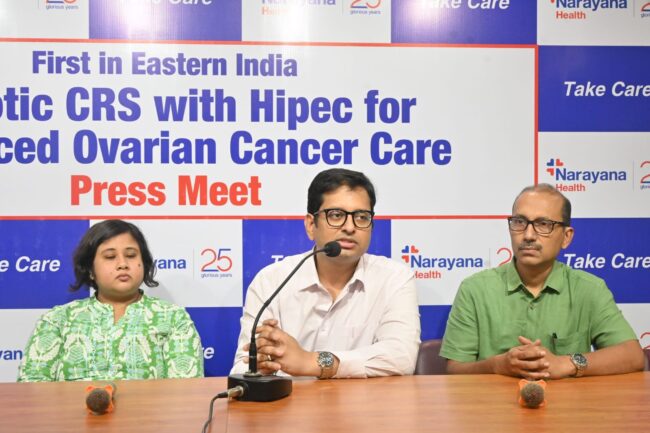
That response changed what was surgically possible. With low residual disease and a tumour mass under 8 cm, the tumour board offered her Robotic CRS instead of open surgery, the same cancer-clearing operation performed through small keyhole incisions rather than one large abdominal cut, meaning less blood loss, lower infection risk, and a faster recovery.The robotic surgery took close to 5 hours and achieved what surgeons call complete cytoreduction, meaning no visible cancer remained. Immediately after, the surgical team performed HIPEC, circulating heated chemotherapy (Cisplatin) through the abdominal cavity for 90 minutes at 42°C to target any remaining microscopic cancer cells. She has since completed follow-up chemotherapy and is on planned maintenance therapy with a PARP inhibitor, a drug that helps prevent the cancer from returning.Dr. Kaustav Basu, Clinical Lead and Senior Consultant, Gynaecologic Oncology, Narayana Hospital, Howrah, said: “Advanced ovarian cancer with abdominal spread has traditionally meant extensive open surgery. What made this case significant was that despite how advanced the disease was at diagnosis, her strong response to chemotherapy and low residual disease allowed us to safely offer the robotic route instead. Combining Robotic CRS with HIPEC in a single sitting meant we could clear the visible disease and treat what remained microscopically, without the extended recovery that a large abdominal incision would have meant for her.”Dr. Suman Mallik, Clinical Director & Sr Consultant – Radiation Oncology, Narayana Hospital, Howrah added; “Robotic CRS with HIPEC marks a significant advancement in ovarian cancer care, offering carefully selected patients effective cancer clearance through a less invasive approach, enabling faster recovery without compromising outcomes.”Dr. Manas Khan, Sr Consultant – Anaesthesiology, Narayana Hospital, Howrah mentioned -“This procedure demonstrates that advanced ovarian cancer patients with good health and low tumour volume can safely undergo robotic CRS with HIPEC, expanding minimally invasive treatment possibilities in Eastern India.”Mr. Ajit Kumar Bellamkonda, Facility Director, Narayana Hospital, Howrah & Chunavati, added: “Patient selection, guided by a multidisciplinary tumour board, is what makes offering advanced options like Robotic CRS with HIPEC safe. We are proud that our team in the Eastern region can now bring this level of specialised care to patients who would otherwise have had to travel for it. This reflects the strength of our clinical protocols and our commitment to advanced, minimally invasive cancer care across Eastern India.”Cytoreductive Surgery with HIPEC is linked to meaningfully better survival in appropriately selected patients with advanced ovarian cancer, with published survival rates in the 50 to 60 percent range. The procedure has traditionally required a large abdominal incision, adding surgical complexity and slowing recovery. The robotic approach delivers the same level of cancer clearance without that incision, and this case shows that even patients with advanced, widely spread disease, provided they are in good overall health and have a low disease volume (tumour mass under 8 cm), can safely be offered this less invasive option without compromising on outcomes.
